Real talk before you book
Komodo is one of the great dive destinations on the planet. It's also not where you go to learn. The currents here aren't the gentle drift of a Bali reef — they can be ripping 3-knot down-currents that pin your fins to the wall. If you're an Open Water diver with under 30 logged dives, do a couple of dive days first, get your buoyancy reliable, then think about a liveaboard.
Minimum honest recommendation: Advanced Open Water + 30 logged dives, ideally with current experience. Some operators still take low-cert divers on the calmer sites and pretend that covers it. It doesn't. Komodo's value comes from sites with current, and those sites filter out the inexperienced fast.
If you're solid on gear and current — ok, let's go.
Why divers fly halfway around the world for this
Two reasons: water that's still alive, and a frankly ridiculous list of pelagics on a single circuit.
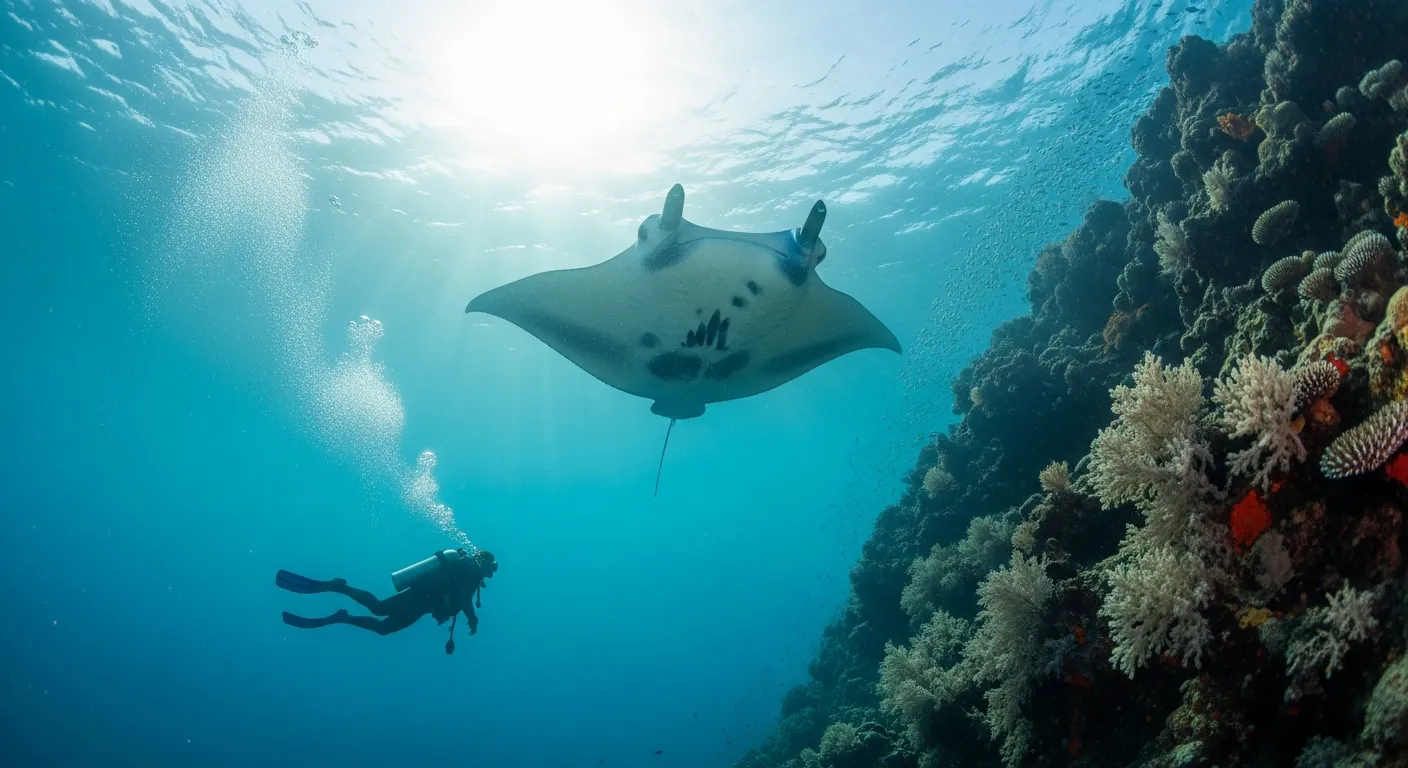
In one 4-day liveaboard you can reasonably expect mantas (resident year-round, peak Dec–Mar), white-tip and grey reef sharks, the occasional eagle ray, schooling jacks, big napoleons, turtles on every dive, an absurd density of macro on the muck sites, and — if you're lucky and patient — a hammerhead at one of the southern pinnacles. The reef itself is in shape that most of Southeast Asia hasn't seen since the early 2000s.
The other thing nobody puts in the brochures: visibility is good but variable. Plan for 12–25m most of the year. Some southern sites get 30m+. After heavy rain in Jan–Feb it can drop to 8m in northern sites. It's a real ocean, not an aquarium.
The signature sites — what they actually feel like
Komodo's central dive area is roughly the strait between Komodo Island and Rinca, plus the channels north of Komodo. A liveaboard usually hits 5–7 of these over 3 nights:
Batu Bolong
A pinnacle that breaks the surface, walls dropping to 40m+ on every side. Soft corals, schooling fish, reef sharks if you stay alert at 25m. The site to know: stay on the lee side. The current side is for instructors, not for "I'll be fine." First-timers love this site because every direction is colour.
Crystal Rock + Castle Rock
The famous twin pinnacles in the Gili Lawa Laut area. Schooling jacks, dogtooth tuna, white-tips off the slope. You drop into current, glide along the wall, and the schools come to you. Reverse current possible — listen to the briefing.
Manta Point (Karang Makassar)
Cleaning station + sandy plateau. You don't dive deep here (10–15m); you hover and watch mantas glide past at touching distance. Timing is everything — slack tide or incoming. Wrong tide and it's a featureless sand patch. Good captains check the tide chart unprompted.
Cauldron (Shotgun)
The signature ride. A bowl-shaped reef where on the right tide, current sucks you through a narrow opening and "shoots" you out the other side. Sharks line the channel waiting for prey to wash through. Hold your reg, don't fight it. This is a current dive — when conditions aren't right, good operators skip it. Bad operators force it.
Batu Tiga + the southern sites
Three pinnacles in colder water (down to 22°C), heavier current, less visited. You come here for the fish density. If you're chasing schooling pelagics or hammerheads, the south is where you go. Most 3-night trips don't go this far south — ask before you book if it matters to you.
Day boats vs liveaboard
If you have 2–3 days in Labuan Bajo, day boats are fine — most run 2 or 3 dives, return to harbour at sunset. Crystal Rock, Batu Bolong, Manta Point, Sebayur all reachable from town.
If you have 4+ days, switch to liveaboard. Reasons:
- Better timing. The boat is already at the dive site at slack tide, not steaming there from harbour.
- Two more dives per day. Day boats average 5–6 dives in a 3-day trip. Liveaboards push 9–12 in the same time.
- Sites south of Komodo are realistically only on liveaboard itineraries.
- Sunrise + dusk dives. The bioluminescence on a moonless night dive at Wainilu is one of the best dives in the country.
- No commute fatigue. You sleep where you dive.
The cost gap is smaller than people think — a 3-night liveaboard with all dives included is often $50–150 more total than 3 days of day boats with multiple transfers, equipment rental, and harbour overhead.
Tank, nitrox, and the gear question
Almost all Komodo liveaboards offer nitrox — and it's worth taking. Bottom times go from 35 minutes to 50 on the deeper sites, which on Crystal Rock or Castle Rock makes a real difference. Budget about $50 supplement for the trip.
Steel 12L is the standard, often 15L on request. Bring your own dive computer, mask, regs if you have them. Rental gear on Komodo boats is fine but skews "well-used" — your own kit is more comfortable for a 4-day trip.
Don't forget: a reef hook (current dives), a surface marker buoy, and dive insurance (DAN or equivalent — Indonesian medical evac is expensive without coverage). Komodo has one chamber in Bali; that's a 1-hour flight and not the trip you want to extend.
When to go — for diving specifically
- April to October: dry season, calm seas, 25–30m viz at most northern sites. Mantas present but less concentrated.
- November to March: wet season, more current, manta peak season (Dec–Mar — you can see 20+ mantas at Karang Makassar in one drift). Viz drops to 12–18m. Some southern sites are too rough.
- The sweet spot: late April to mid-May, or mid-September. Dry, fewer crowds, mantas just starting/ending their peak presence.
Booking — what actually matters
The boat you pick determines almost everything: which sites you'll hit, how the dive day is paced, whether the dive deck is set up well, whether the divemaster knows the cleaning stations. A good operator will give you specifics on cert requirements, recent sightings, and tide-keyed itinerary planning. A bad one tries to oversell.
I send dive friends to charterphinisi.com when they ask. It only lists verified phinisi operators in Labuan Bajo, the calendar shows real per-cabin availability, and dive packages are itemised — so you can see whether nitrox is included, whether the boat carries a compressor, whether the divemaster ratios are reasonable. Worth a 10-minute browse before you commit.
So, ready to dive Komodo?
You'll come back from this place changed about what you thought "good diving" meant. Three days here is excellent. Five days and you'll be planning your next trip on the flight home.
Pick your dates, head to charterphinisi.com, find a verified phinisi with a real dive program (compressor onboard, nitrox, current-experienced divemasters), and book the trip that fits your cert level and your group. Peak diving slots in manta season (December–February) book out 8–12 weeks ahead. Don't wait too long.