What "liveaboard" actually means
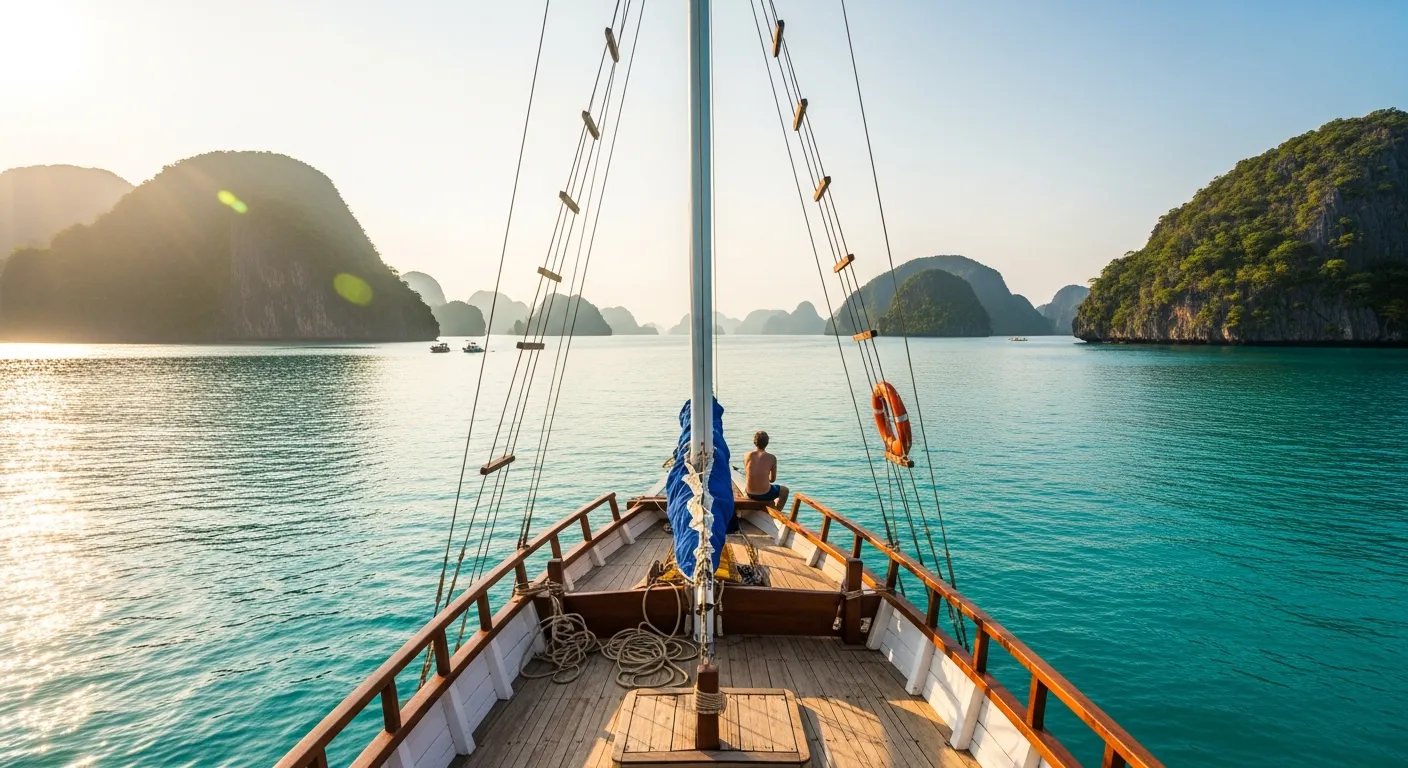
Quick disambiguation before we go anywhere — when people say "Komodo liveaboard," they don't mean a cruise ship. They mean you sleep on a small wooden boat (usually a phinisi, the traditional Indonesian sailing rig) for 2 to 5 nights, anchored each evening in a different bay, eating meals the chef cooked on deck, and waking up in places you can't drive to. There are 8 to 14 of you on board, sometimes fewer. The "ship" is roughly the size of a large house tipped sideways.
That's the whole concept. And it's why people who do it once tend to come back.
The day-1 onboarding moment
You arrive at Labuan Bajo harbour, find your boat among the dozens lined up at the pier, walk a wobbly plank, and within twenty minutes you've forgotten what wifi is. There's a real moment that happens about an hour out — the engines settle into a low hum, the marina noise drops away, the limestone karst islands start rising out of the water on every side, and you realise the next three days have no schedule you didn't agree to. It's quietly disorienting in the best way.
Pro tip: don't try to "rest" on day 1. Sit on the bow, let the speed and the salt do the work. Your nervous system is going to recalibrate whether you help it or not.
The rhythm of a typical day
Liveaboard time runs different. Here's roughly what a day looks like, though the order shuffles:
Pre-dawn
If you've signed up for the Padar sunrise hike, you're up at 4:30 AM, on the dinghy by 5:00, climbing in the dark with a headlamp. The boat anchors in a bay below the trail. Twenty-five minutes up, and you reach the famous viewpoint — three crescent bays, three different colours of sand, with the light changing every thirty seconds as the sun rises behind the mountains. Even the people who said they don't like hiking go quiet up there.
If you skipped the hike, you're hearing the soft slosh of water against the hull at 6 AM and that's actually pretty good too.
Breakfast on deck
Fresh fruit, eggs your way, banana fritters, kopi. The whole bow becomes the dining room. The view is wherever the boat happened to anchor — usually somewhere unreasonably scenic. By 8 AM you're already in your rashguard, looking forward to the first dive.
Dive #1 (or snorkel)
Most boats run two morning dives. The classic sites — Batu Bolong, Crystal Rock, Castle Rock, Manta Point — are within a half-hour cruise of each other. You roll backward off the dinghy, descend, and the reef is just immediately there. Schooling jacks. White-tip sharks. A turtle who looks at you like you're trespassing on his commute.
If you snorkel: same sites, but stay near the surface where the sun catches the soft corals and the manta wings glow.
Lazy afternoon
This is the part nobody talks about that turns out to be the best part. You're done with morning dives, lunch is served (proper food — fresh-grilled fish, rice, sambal, vegetables, and somehow always a fresh-cut watermelon), and you have three hours before the next stop. People nap. Read. Stare at clouds. Float in the water beside the boat. The pace of liveaboard life is the actual product — you're not paying for activities, you're paying to slow your week down.
Sunset stop
Most boats anchor near a beach or a small island for sunset. You take the dinghy ashore, climb a small hill, watch the sun drop over the strait between two islands. Take fewer photos than you think you should. The sky here goes through colour shifts you don't see in cities — orange to magenta to violet to that weird blue-green right before dark.
Night
Dinner on deck under string lights, with whatever music the captain's playing softly through small speakers. After dessert (if you're lucky, fried banana with chocolate sauce), you can lie on the upper deck and look at stars that don't exist in cities anymore. On a moonless night near Padar you'll see the Milky Way as a band, not a vague smudge. Some boats turn off their deck lights so guests can see it properly. That's the test of a good boat — they understand which lights to turn off.
What surprises people
A few things first-timers usually aren't expecting:
- You make friends. Open-trip liveaboards put you with strangers, and three days of sharing meals + reefs + sunsets in the same small space turns most groups into a kind of temporary family. Many people exchange numbers on the last day.
- The food is genuinely good. Phinisi chefs cook in a galley the size of a closet and somehow plate three meals plus snacks per day, all fresh. The bar is "you'll talk about that meal a year later."
- You sleep deeply. The boat's gentle motion at anchor knocks people out in a way no hotel pillow has ever managed.
- There's no pressure to be productive. It feels strange at first if your normal life is busy. By day 2 you don't care.
The boat is the experience
This is the part most blog guides bury, so let me put it up top: the boat you pick is the trip. Cabin layout, deck size, captain's experience, chef quality, dive equipment, which itinerary they default to — those make 90% of how the days unfold. A budget boat at the wrong end of the market and a thoughtful mid-range phinisi at the right end aren't the same product, even if both technically take you to the same islands.
When you compare liveaboards, look at: cabin air-con (yes really, dry-season days hit 32°C), private bathroom or shared, deck shade vs sun, what the captain says about timing manta point relative to the tide (the good ones bring up tides unprompted), and whether the boat sleeps 8 vs 14 (smaller usually means a tighter group dynamic).
I send friends to charterphinisi.com when they ask me to compare. They list verified phinisi operators in Labuan Bajo with real per-cabin availability and upfront prices — no email tag with five different agents to find out what something actually costs. Worth a 10-minute browse before you commit.
So, ready?
Three nights on a Komodo liveaboard recalibrates how you think about "vacation." Five nights and you start considering whether you actually need wifi at all in your normal life.
If you're going to do it, do it on the right boat. Pick your dates, head to charterphinisi.com, browse what's actually available across the verified operators, and book the cabin that fits your trip — not someone else's package. The good ones in peak season (July–September) book out 6–8 weeks ahead. Don't wait too long.