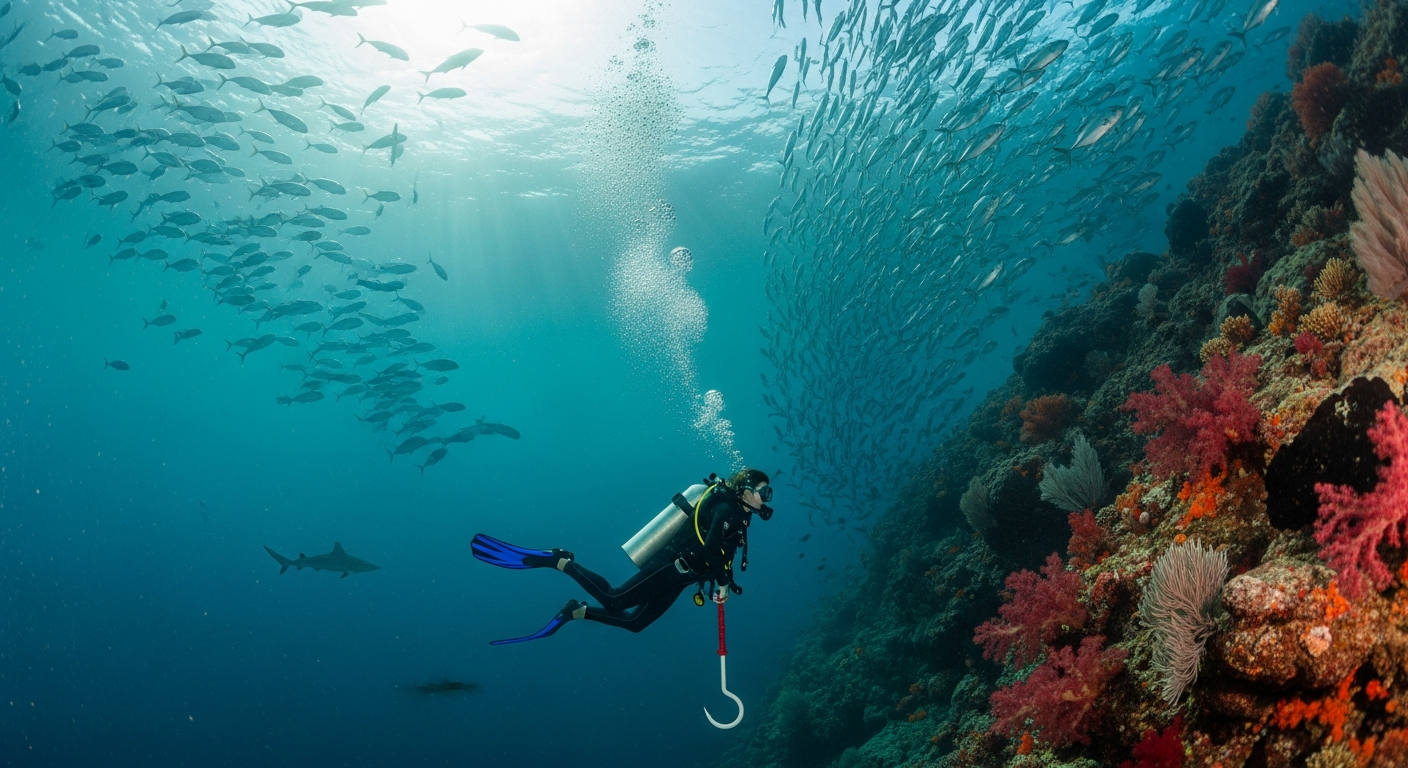
A lot of places claim "world-class diving." Most overpromise. Komodo doesn't have to — the place lives up to the marketing in a way I haven't seen elsewhere in Southeast Asia. Strong currents pulling cold nutrient-rich water past two distinct ocean basins (Indian and Pacific) means you get pelagics in the blue and macro on the wall, often on the same dive.
Reef sharks, eagle rays, mantas at multiple sites, schooling jacks, frogfish, pygmy seahorses, nudibranchs in colors you didn't know existed, and walls that drop into deep blue water. Visibility 15–30m on a good day. Water 25–29°C year round.
If you're a certified diver planning your first Komodo trip, this is the friend-to-friend guide I wish I'd had.
The certification reality
Open Water Diver (OWD) — minimum technically allowed, but I genuinely don't recommend it for most Komodo sites. The currents here are real. Most ops will gate the harder sites (Castle Rock, Crystal Rock, Shotgun) to AOWD or higher.
Advanced Open Water (AOWD) — the practical minimum. You'll have access to almost all sites with a decent dive guide.
20+ logged dives — strongly recommended on top of AOWD. Komodo is not where you should be working out buoyancy or air-consumption issues. If you're freshly certified, do a few warm-up dives in Bali or Lembongan before flying east.
Nitrox certification — worth getting before you come. The longer bottom times help in 25–30m current dives, and most premium boats have Nitrox fills onboard.
The bucket-list sites
Komodo has 50+ named dive sites. These are the ones every diver should plan for:
Castle Rock
The signature dive. A pinnacle that rises from deep water in the northern park. Schooling jacks, big-eye trevallies, dogtooth tuna, sharks. Strong current — AOWD + reef hook required. Time it right and you hover behind a wall of jacks the size of a swimming pool. Easily one of the great dives in Asia.
Crystal Rock
Just south of Castle. Less current, more coral. Reef sharks patrol the shallower section. Beautiful soft coral garden on the southwest side. Good "step down" from Castle if conditions are heavy.
Manta Point (Karang Makassar)
The cleaning station everyone knows about. Hook in, watch reef mantas glide overhead. Snorkelers can do this site too, but as a diver you spend longer at depth and get the slow-glide perspective from below.
Batu Bolong
A submerged pinnacle in a current channel. The current funnels around the rock — pick the lee side and the diversity is staggering. Hard coral, soft coral, schooling fish, occasional shark. Probably my favorite site in Komodo.
Cannibal Rock (south Komodo)
Macro paradise. Pygmy seahorses, frogfish, nudibranchs, ghost pipefish. Less current than the northern sites. Often run on the southern liveaboard routes.
Shotgun (The Cauldron)
Famous for the down-current that "shoots" you over a sandy plateau then up into the blue. For experienced divers only. Don't book this if you've never done a thermocline-influenced drift.
When to dive
April–November (dry season) is peak. Visibility best (often 25–30m), water calmest at the surface, currents most predictable.
June–September is the absolute peak — minimal rain, very stable conditions. Also priciest and most crowded.
Wet season (December–March): visibility drops to 10–15m, some sites get blown out by surface chop. Mantas at Manta Alley are actually more reliable in this season because of plankton blooms — but most operators don't run full schedules.
For first-time Komodo divers, aim May, June, September, or October. Best ratio of conditions to crowds.
Day diving vs liveaboard
You have two ways to dive Komodo:
Day diving from Labuan Bajo
Day trips out of the harbor — 2–3 dives per day, return to land for the night. Cheaper, more flexible, and you sleep in a real bed.
Good day op: ~IDR 2–2.5M per day for 2 dives + lunch + equipment. The reputable ones (Wicked Diving, Dive Komodo, Manta Rhei) are booked weeks out in peak season.
The limitation: you can only reach the closer sites (Sebayur, Mawan, Manta Point, Tatawa). The far-out sites — Castle Rock, Crystal Rock, Cannibal Rock — are too remote for day trips and require an overnight boat.
Multi-day liveaboard
A 4D3N or 7D6N dive liveaboard is the standard way to dive Komodo properly. You sleep on the boat, wake up at the dive site, do 4 dives a day instead of 2.
Mid-tier dive liveaboards run IDR 25–40M for 4D3N. Premium (onboard dive instructors and Nitrox) starts around IDR 50M+ for similar.
My honest take: if you came to Indonesia specifically to dive, do the liveaboard. The day-trip version misses the best sites and you spend 90 minutes each way on the speedboat. The liveaboard puts you on Castle Rock at slack tide, which is what you actually came for.
If you're combining diving with a Komodo dragons + Padar tourist trip, the day-diving option lets you do both. Otherwise, full dive liveaboard.
What to bring
- Your own mask, fins, computer — boat rentals are fine but your own setup is better
- Reef hook — most boats supply these but bringing your own is wise
- DAN insurance — non-negotiable, the chamber is in Bali (6+ hours from Labuan Bajo)
- 3mm wetsuit — water is 25–29°C, full 3mm is comfortable on multi-dive days
- Spare strap, mask defog, dive light — small items that make the difference
- Surface marker buoy + reel — your guide will have one, but bringing your own is dive insurance
Skip the spear (illegal in the park), skip the drone (banned), skip the heavy wetsuit (overkill).
Booking smart
The Labuan Bajo dive market has gotten enormous. Some operators are excellent. Some run boats with old equipment, untrained divemasters, and zero respect for tide timing. The price differential between "fine" and "excellent" is small enough that you should just book excellent.
I usually start with charterphinisi.com for dive liveaboards — reputable phinisi with onboard dive operations (Elbark, Vinca, and higher-tier boats for serious dive trips), with real photos of the dive deck setup, clear pricing including park fees, and verified availability. The team can also match you to a boat based on your certification level and the sites you specifically want to hit.
For day diving, they can route you to Wicked Diving, Dive Komodo, or Manta Rhei depending on schedule.
Final thoughts
Diving Komodo isn't a casual holiday dive trip. The currents are real, the boat logistics matter, and the difference between a great trip and an okay one comes down to operator quality and tide timing. But when it works — when you hit Castle Rock at the right slack and you're suddenly inside a tornado of jacks while a reef shark cruises past — there's nothing else like it.
You came for the marine life. You'll leave with a different idea of what "good diving" actually means.
Ready to plan?
When you've picked your dates, head over to charterphinisi.com — filter by dive-focused liveaboards, pick a boat that matches your certification and the sites you want, and lock the date. Aim for June or September if you can. The good dive liveaboards sell out 2–3 months ahead in peak season. The mantas don't care; the boats fill up.