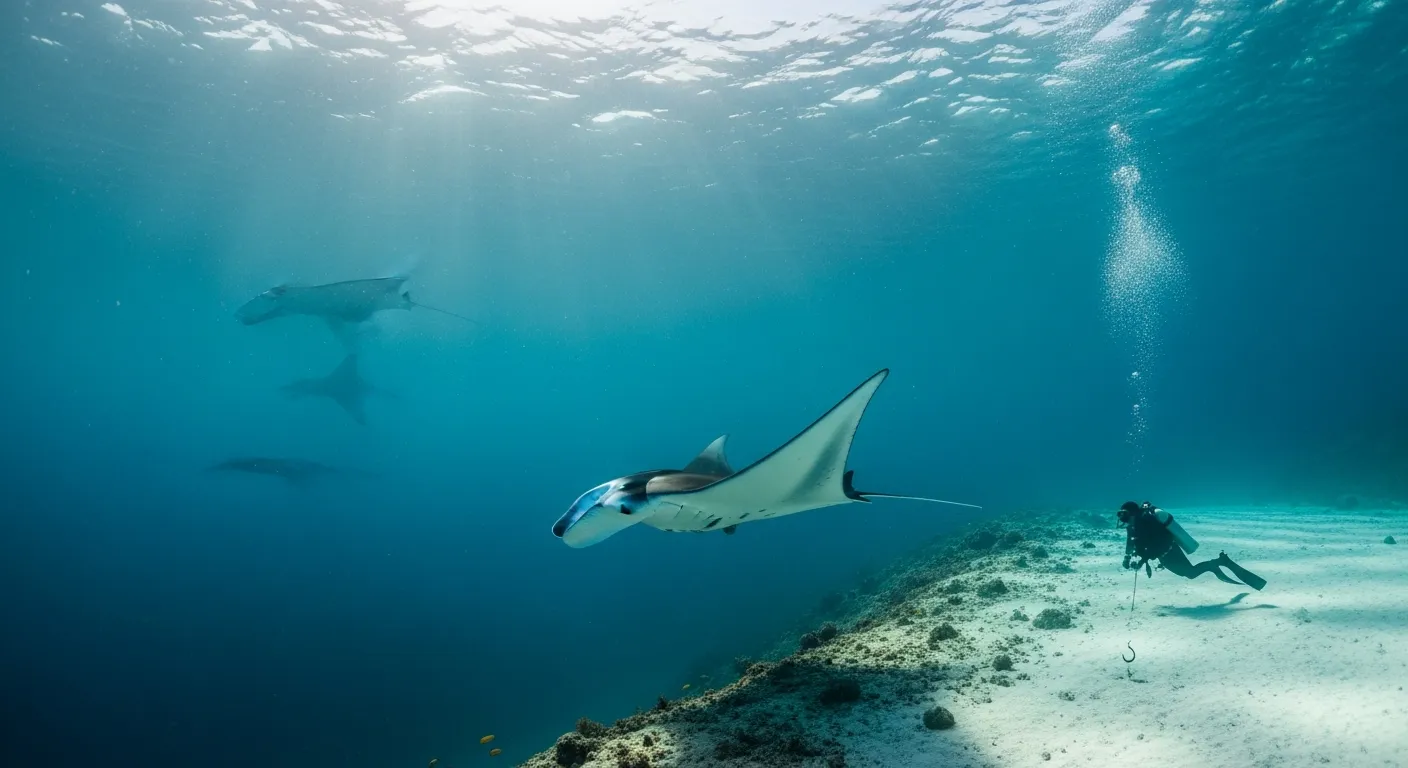
The first time a manta cruised over me at Manta Point, I genuinely forgot to breathe. I just floated there, regulator hanging a little loose, watching this thing — eight meters wingtip to wingtip — glide three feet above my head like it was mildly bored by my existence. My dive buddy had to whack his tank a few times to snap me out of it. He told me later he did the exact same thing on his first dive there. Everyone does.
If you're planning a Komodo trip and Manta Point is on your list, this is the post I wish I'd read before I went. No marketing fluff, no "world-class destination" filler. Just what it's actually like, what surprised me, and how to not waste your money on the wrong boat.
What and where Manta Point actually is
Manta Point isn't one site — it's a few overlapping zones. The most-dived one is Karang Makassar, a long sandy ridge between Komodo Island and Tatawa Besar where reef mantas come in to get cleaned by little wrasse. There's also Mawan, shallower and gentler, and Manta Alley down south near Padar, which is moodier and less reliable but spectacular when the mantas decide to show up.
Most day trips and liveaboards out of Labuan Bajo will take you to Karang Makassar. It's about 90 minutes from town by phinisi, and once you're geared up and rolling backwards off the side, you're hunting mantas in maybe 12 meters of water with the current ripping past you.
When to go (and when really not to)
Best months: April through November. This is dry season — water is clearest, surface conditions are friendly, and the mantas are most consistent. July and August are peak; you'll share the site with other boats but sightings are nearly guaranteed.
December through March is wet season. Mantas can still be around, but visibility drops, the chop gets ugly, and some boats just don't run those routes. If your dates are locked into that window, manage your expectations.
The other thing that matters more than the month: the tide. Manta Point dives best on an incoming tide when nutrient-rich water flushes the cleaning station and the mantas line up. Good operators time it. Bad ones drop you in whenever and shrug if nothing shows. Ask before you book — if the dive guide can't talk tides, swim away.
What the dive is actually like
Here's the thing nobody tells you on the brochure: Manta Point is a current dive. Not a lazy drift — there's real water moving. You hook in (literally — you bring a reef hook, clip onto a piece of dead coral or rubble, and let yourself flag out like a kite), and you wait.
If you're lucky, mantas appear out of the blue water like ghosts. They cruise the cleaning station, sometimes ten or fifteen of them in a slow lazy loop, sometimes a single big bull doing barrel rolls right above your head. They don't care about you. You are a barnacle on the ocean floor as far as they're concerned. Don't chase them — they'll come closer than you'd think possible if you stay still.
Average depth is 10–15m. Average duration is 45 minutes to an hour. You'll burn air a little faster than usual because of the current and, honestly, the adrenaline.
Skills you actually need
You don't need to be Jacques Cousteau, but Manta Point isn't a beginner site either. Be honest with yourself before you book:
- Open Water minimum, but Advanced is much better
- Buoyancy under control — you'll be hovering near coral in current
- 20+ logged dives, ideally
- Comfortable using a reef hook (any decent guide will brief you on the boat)
If you've only got eight pool dives and a holiday cert, do a couple of warm-up dives at Siaba or Tatawa first. Most good operators plan it that way anyway.
What I wish someone had told me
A few things nobody warns you about:
- The current can flip mid-trip. A site that was friendly in the morning can be ripping by afternoon. Don't get too comfortable.
- Mantas aren't guaranteed. They almost always show — but I've talked to divers who did three trips and saw zero on day one, then thirty on day two. It's wild animals; it's not Disneyland.
- Don't touch. Don't chase. Don't get under them. Their slime coat is their immune system. Operators who let clients act stupid are the ones killing the site.
- GoPro on a stick is fine. Drones are not — and most boats won't let you fly anyway. Too many tour ops have ruined that.
Booking it without getting burned
This is where most people get screwed. Labuan Bajo has a million boat agents and the quality range is enormous. The cheap day boats are fine for a couple of dives but cramped and rushed. The good liveaboards put you on dive sites at the right tide, with proper guides and real safety briefings.
I've personally had way better experiences booking through charterphinisi.com — they do the boring work of vetting operators, checking insurance, and matching you with a phinisi that actually fits your group size and dive level. You can browse the real boats, see actual cabin availability, and skip the WhatsApp ping-pong with five different agents.
For Manta Point specifically, you've got two paths:
- Day trip from Labuan Bajo — 1–2 dives at Manta Point plus a stop at Padar. Cheaper, fits in a single day, you sleep in town. Fine if you've only got 24–48 hours.
- Multi-day liveaboard — 3D2N or longer on a phinisi. You dive Manta Point AND the rest of the park (Batu Bolong, Crystal Rock, Castle Rock — all bucket-list dives). Way better if you can swing it.
If you're a serious diver and you came all the way to Indonesia, do the liveaboard. The day trip is the trailer. The liveaboard is the movie.
Ready to plan it?
Manta Point is the kind of dive that ruins other dive sites for you a little. In a good way. The mantas show up, the visibility is real, and the experience genuinely changes how you think about big animals in the wild. But it's not the kind of dive to book on autopilot — pick your boat carefully, time the tide, and stay within your skill level.
When you're ready, head over to charterphinisi.com — pick a phinisi that fits your group, lock the dates that line up with proper tides, and let the team match the right boat to your dive level. They'll handle the boring stuff so you can focus on remembering to breathe when the first manta drops in.
The cleaning station has been running for centuries. The mantas will be there. The only question is when you'll be.