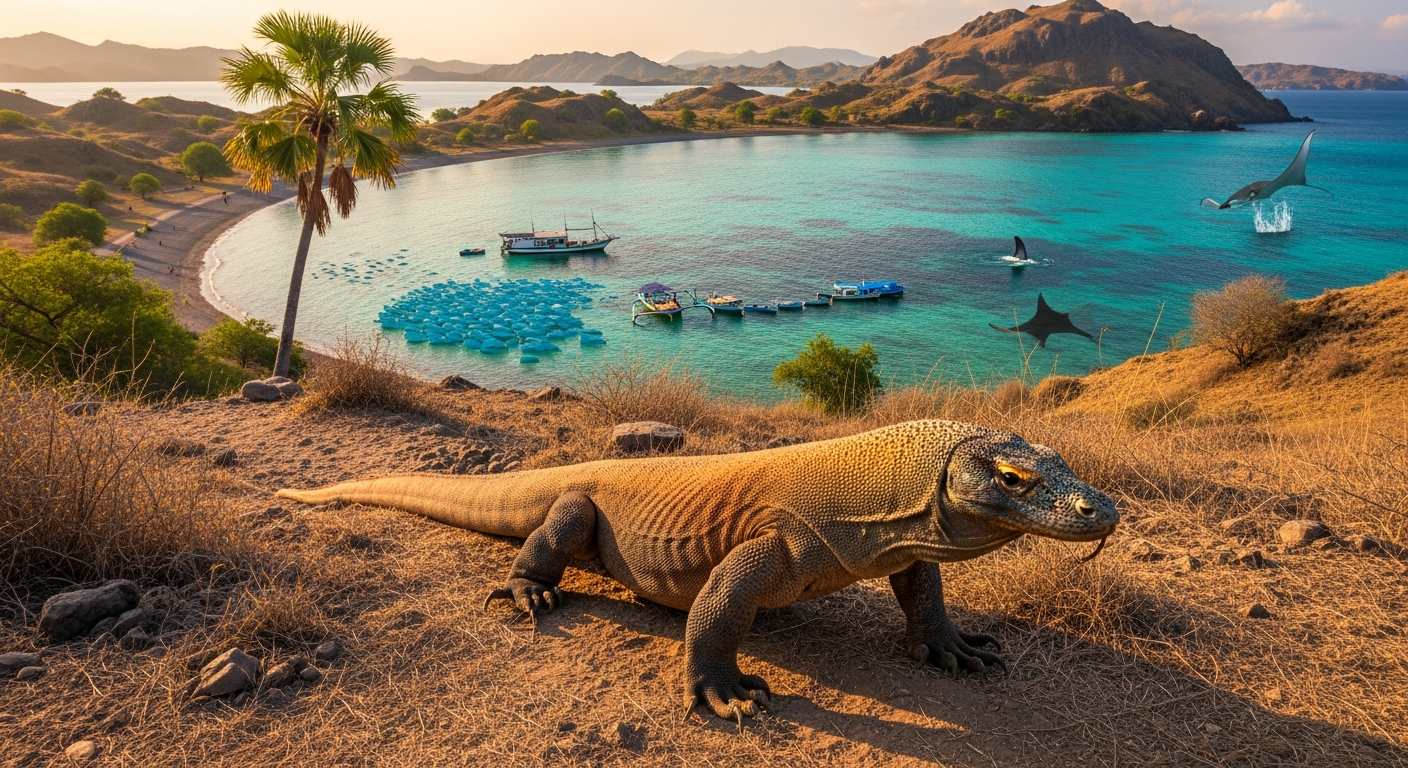
Komodo Wildlife: A By-Species Field Guide for Real Trips
Let me tell you something most travelers don't realize until they're on the boat: Komodo isn't a dragons-only destination.
It's one of the most concentrated wildlife corridors in Southeast Asia. The land animals are surreal. The marine life is borderline science fiction. The skies fill with creatures you didn't know existed. And every species has its own best season, best time of day, and best location.
I've spent enough days in Komodo National Park to put together a real field guide — by species, with honest timing notes — so you can plan your trip around what you actually want to see. Let's go.
1. Komodo Dragon (Varanus komodoensis)
The headline animal. The reason you probably first heard of this place.
- Size: 2.5-3 meters, up to 70+ kg
- Where to see them: Komodo Island ranger station OR Rinca Island ranger station. Rinca has wilder feel + smaller crowds.
- Best time of day: 6-9 AM (cool, more active). They go lethargic by midday.
- Best season: April-June and September-October. Cooler = more dragon movement.
- What to expect: A ranger walks you 30-90 min along marked trails. You'll see anywhere from 3 to 15 dragons depending on the day. Most are lying in the sun, completely indifferent to you.
- Pro tip: Mention if you're on your period — they have an extraordinary sense of smell. Not dangerous with a ranger, but worth flagging.
Komodos are venomous (their bite contains anticoagulants), and they take down water buffalo via blood loss over days. In real life, around a ranger, they're more like grumpy old men. The danger is real but managed.
2. Reef Manta Ray (Mobula alfredi)
The other heavyweight encounter — and the one that emotionally wrecks first-time snorkelers in the best way.
- Size: 3-5 meter wingspan
- Where to see them: Manta Point (Karang Makassar) channel. Manta Alley in south Komodo for advanced divers.
- Best time of day: Mid-morning to early afternoon — tide-driven.
- Best season: December-March (plankton bloom = peak density). Year-round sightings; just lower numbers in dry months.
- What to expect: Snorkel above a sandy channel 8-12m deep. Mantas glide in to get cleaned by smaller fish. They're completely chill, no stinger, no teeth. You hover. They glide. Eye contact happens.
- Pro tip: Snorkeling is genuinely better than diving for first-timers — mantas swim shallow, you can stay in the water longer, no bubbles to spook them.
3. Green & Hawksbill Sea Turtles
The sleeper hit of every Komodo trip.
- Where: Pink Beach reef, Siaba Besar ("Turtle City"), Kanawa, Sebayur, basically everywhere with shallow coral.
- Best time: All day, year-round. Visibility peaks April-October.
- What to expect: Slow, lazy, completely uninterested in you. You'll see 3-10 per snorkel session at Siaba.
- Pro tip: Don't touch. Don't chase. Float quietly nearby and they'll often come closer to investigate.
4. Giant Fruit Bats / Flying Foxes (Pteropus vampyrus)
The most-underrated wildlife moment in the entire park.
- Size: Wingspan up to 1.5 meters
- Where: Kalong Island (literally means "bat island"). Mangrove roost.
- Best time: Dusk — exodus begins 15-20 min before sunset.
- Best season: Year-round. Slightly fewer on full-moon nights.
- What to expect: Thousands of bats explode out of the mangroves in waves, streaming across an orange sky toward Flores Island to feed. Silent. Surreal. Lasts 20-25 minutes.
- Pro tip: This won't photograph well. Just be there.
5. Whitetip & Blacktip Reef Sharks
Not dangerous. Mostly shy. Always cool.
- Where: Deeper edges of every major reef — Castle Rock, Crystal Rock, Manta Point edges, Tatawa Besar.
- Best time: Morning slack tide. Visibility matters more than time.
- What to expect: Usually 1-2m sharks patrolling along the reef edge. They notice you. They keep moving.
- Pro tip: Don't make sudden movements toward them. Just stay calm and watch.
6. Timor Deer (Cervus timorensis)
The quiet protagonist — they're the dragons' primary food source.
- Where: All over Komodo and Rinca, grazing in the savanna.
- Best time: Cool early morning or late afternoon.
- What to notice: They are constantly alert. Ears twitching. Eyes scanning. They've evolved to survive being prey, and you can see it in real time.
7. Crab-eating Macaques
- Where: Mostly Rinca Island. Hang around the ranger trails.
- Behavior: Cute. Curious. Will absolutely steal your snacks if you have any on you.
- Pro tip: Don't feed them. It corrupts the troop dynamics.
8. Yellow-crested Cockatoos
Critically endangered, dramatic, very loud.
- Where: Komodo and Rinca, often in the higher savanna treelines.
- Best time: Sunrise and sunset, when they're loudest.
- What to listen for: A piercing screech echoing across the bay.
- Why it matters: Population dropped from millions in the 1980s to a few thousand today. Hearing them in the wild is a rare modern privilege.
9. Sea Eagles & Ospreys
- Where: Cliffs along Komodo and Rinca, sometimes circling Padar.
- Best time: Mid-morning thermals.
- What to expect: Big raptors riding updrafts off the cliffs. Look up.
10. Octopus, Cuttlefish, and Smaller Critters
For the macro nerds.
- Where: Cannibal Rock (south Komodo), Sebayur shallows, Tatawa Kecil.
- Best time: Slack tide.
- What to expect: Octopus that change color in front of you. Cuttlefish flashing patterns. Frogfish. Mandarin fish in late afternoon mating displays.
11. Eagle Rays + Mola Mola (Rare)
- Eagle rays: Occasional flyovers at Manta Point and Batu Bolong.
- Mola mola (sunfish): Very rare. Cold-water upwellings in south Komodo, mostly July-September.
- Honest take: Don't book a trip expecting these. Treat them as bonuses.
How to Maximize Your Wildlife Trip
1. Go shoulder season
April-June or September-October. Best balance: dragons active, mantas reliable, seas calm, fewer crowds.
2. Stay on the water (liveaboard, not day trips)
Day trips from Labuan Bajo miss the magic-hour wildlife windows. A proper 3-4 night phinisi liveaboard gets you sunrise dragon walks, midday manta sessions, and dusk bat flights — the three best wildlife windows.
3. Bring binoculars
Most travelers don't. Birds-of-prey watching, deer spotting, and even dragon viewing from a distance is way better with even cheap binoculars.
4. Go with a naturalist guide if possible
Some premium phinisi have onboard naturalists or experienced divemasters who can point out species you'd miss. If wildlife is your primary reason for the trip, prioritize this when picking a boat.
5. Pack the right gear
- Mineral reef-safe sunscreen (oxybenzone kills coral)
- A wide hat for sun + bird spotting
- Sturdy closed-toe shoes for trekking
- Patience — wildlife isn't a zoo, you have to wait
A Day-by-Day Wildlife Itinerary
If wildlife is your priority, here's how I'd structure a 4-night trip:
Day 1: Departure + Kelor warm-up snorkel + sunset cruising.
Day 2 — Dragon + Bird Day: Rinca dragon trek at 6 AM (cool, active). Birding stops on the way back. Afternoon snorkel at Pink Beach (turtles). Sunset at Kalong (bats).
Day 3 — Marine Day: Sunrise Padar. Morning Manta Point. Lunch at anchor. Afternoon at Taka Makassar (sandbar + reef life). Evening anchor under stars.
Day 4 — Macro + Pelagics: Morning Batu Bolong (reef sharks, big schools). Afternoon Sebayur (macro). Sunset cruise back toward LBJ.
Day 5: Slow return to harbor.
This hits every major wildlife category. Most off-the-shelf itineraries can be tweaked into this if you ask.
Booking the Trip
The key for wildlife-focused trips is picking a boat with a knowledgeable crew and an itinerary that hits the magic-hour windows (not the rushed midday-only day trip version).
The cleanest way to compare phinisi options — with real itineraries, cabin photos, and the ability to request a custom wildlife-focused route — is charterphinisi.com. Filter by 3-5 night itineraries, ask about onboard naturalists or experienced divemasters, and lock in the boat that matches what you actually want to see.
Time to Meet Some Animals
Komodo's wildlife isn't a zoo. It's not a curated experience. It's an actual ancient ecosystem that you get to slip into for a few days — and if you time it right, the encounters stay with you for life.
If you've been thinking about it, head to charterphinisi.com, pick the dates, pick the boat, and go.
The dragons are sunbathing. The mantas are at the cleaning station. The bats are about to fly. Don't keep them waiting.