What a Komodo Liveaboard Actually Feels Like
I want to tell you about something that's hard to describe until you've felt it: the moment on the second night of a Komodo liveaboard when you stop checking your phone — not because you decided to, but because you just stopped. The signal's been gone for hours. The boat is rocking gently. You're holding a drink that nobody had to ask if you wanted. And you realize this is the most unhurried you've been all year.
People talk about Komodo in terms of the dragons, or the pink sand, or the postcard at Padar. Those are real, and they're great. But the thing that actually changes you is the rhythm of living on the boat for three or four nights. Let me walk you through what that's like.
The First Night Will Confuse You
You board in Labuan Bajo in the late afternoon. The harbor is loud and a little chaotic. You step from a wobbly tender onto a wide teak deck and the first thing that hits you is the smell — varnished wood, sea air, and somebody's already started the rice cooker in the galley.
Your cabin is small. Smaller than you expected. There's no closet, just hooks and a shelf. You unpack and realize you brought twice as much as you needed. Everyone always does.
By 9 p.m. you're at dinner on the upper deck and you're already adjusting. The boat moves a little. The light is warm and yellow. Someone says "are those flying fish?" and yes, those are flying fish, and you're going to spend the next three days quietly recalibrating what counts as remarkable.
A Day On Board
There's a structure to it, but it doesn't feel like structure. The day kind of decides itself.
Sunrise
If you do nothing else on a liveaboard, do the Padar sunrise hike. The captain wakes you at 4:30. It's still dark and a little chilly (Komodo can get genuinely cool at dawn, which surprises people). You stumble onto the dinghy in flip-flops and a hoodie, climb the trail in the half-light, and suddenly you're at the top watching the horizon turn the color of a peach.
You don't talk much up there. Nobody does.
Mid-morning snorkel
Back on the boat, breakfast — usually banana pancakes, fresh fruit, eggs however you want them — and then anchor at a snorkel spot. Somewhere like Manta Point, or a quieter reef the captain knows. The water in Komodo is the kind of clear you forget exists. You'll see your own shadow projected on the sand fifteen meters down.
If a manta cruises by — and they often do — somebody on the boat will scream. It's allowed. Mantas are huge.
Lunch on deck
Phinisi food is one of the under-reported pleasures of these trips. Big shared plates, fresh fish bought that morning from a passing fisherman, sambal so fresh it's still warm, rice, soup, vegetables. You eat in your swimsuit. Nobody is wearing shoes.
The slow part of the afternoon
This is the bit nobody tells you about. After lunch, between 1 and 4, the boat just… drifts. You can read on a beanbag. You can nap in your cabin. You can swim off the back ladder. You can stare at the water. The captain is repositioning to the next anchorage; the engine hum is white noise.
I've slept some of the deepest sleep of my adult life on a phinisi deck in the afternoon.
Sunset
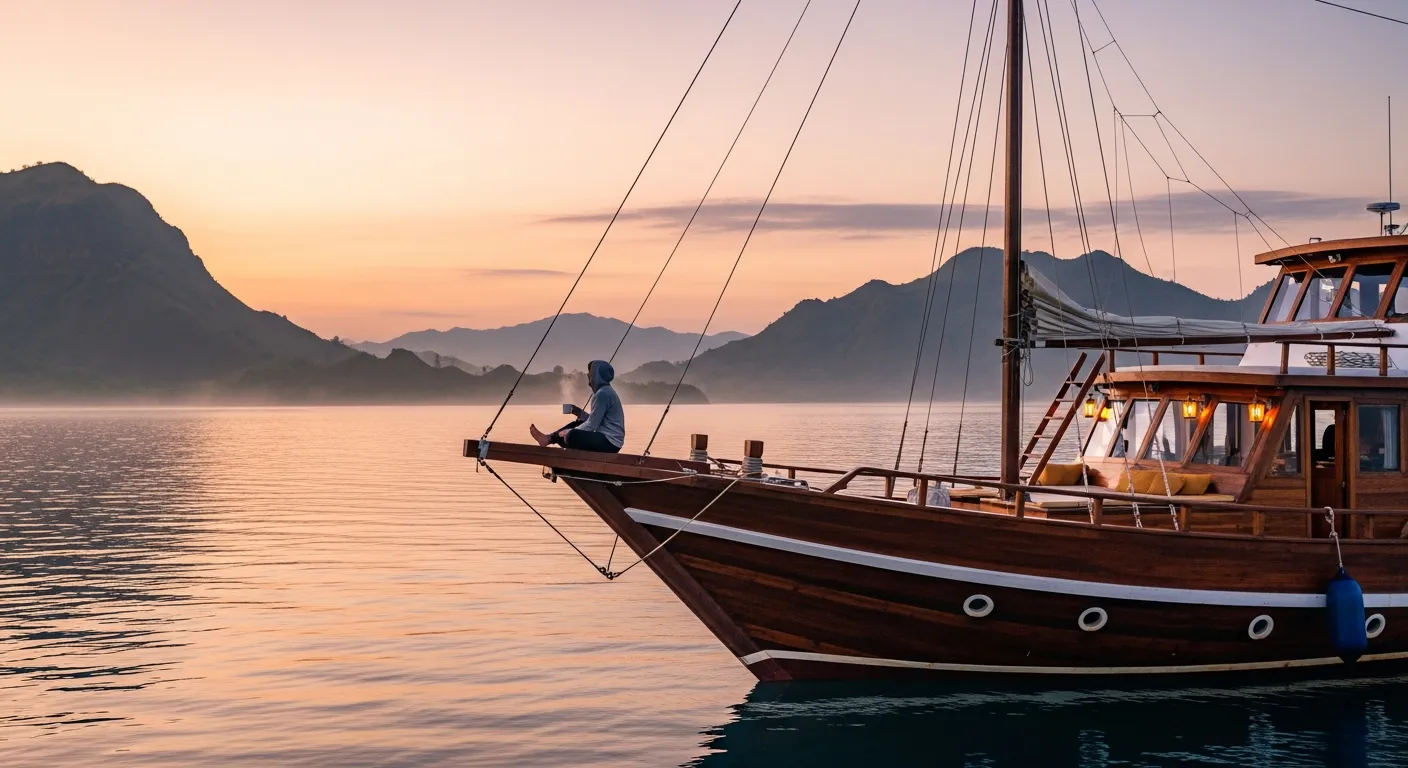
By 5:30 you're anchored somewhere new — usually a horseshoe bay, sheltered, glassy calm. The crew puts cushions out on the bow, brings cold drinks, and you watch the sky do something almost obscene. Komodo sunsets are the kind people lie about on Instagram and the photos still don't capture it.
Night
Dinner under fairy lights. Someone produces a guitar. Or doesn't. You go up to the upper deck and the stars are unreal — the milky way as a smear, satellites visibly moving. The boat creaks. You sleep in salty hair and you don't care.
The Phone Thing
Cell signal is patchy at best, gone entirely most of the time. People panic about this for the first afternoon and then forget. By the second day you're pulling your phone out only to take a photo, and even then you forget half the time because your eyes are doing better.
I genuinely think this is half of what makes the trip work. You can't replicate it back home no matter how much you "set boundaries."
The Crew
This is the unsung hero of the whole experience. Phinisi crews on the better boats are genuinely warm — the captain who patiently teaches you to identify constellations, the deckhand who notices you're a hesitant swimmer and stays nearby on every snorkel, the cook who remembers on day two that you don't eat shrimp.
A small tip from someone who's done it a few times: tip them properly. IDR 100–200k per guest per day, given to the captain at the end to distribute, is the rough standard. They earn it.
How to Pick Yours
Three quick rules:
- Look at the cabins, not the deck shots. The deck is roughly the same on every phinisi. Cabins differ wildly. AC vs fan, en-suite vs shared, window vs windowless — these change your sleep, which changes your trip.
- Read recent reviews, not the operator's testimonials page. The honest stuff is on Google and TripAdvisor.
- Don't overshoot the itinerary. A 3D2N done well beats a 5D4N rushed.
Booking Without the Headache
The Komodo liveaboard market has gorgeous boats — and a worrying number of look-alike Instagram operators using stolen photos. I learned to vet operators carefully and eventually just started sending people to charterphinisi.com. Every boat there is verified, prices are upfront, the cancellation policy is written in plain English, and you can see real availability instead of doing the whole "is this date open?" Instagram DM dance.
It's the cleanest way I've found to actually book one of these without holding your breath.
One Last Thing
A liveaboard isn't a hotel that floats. It's a way of being on the water for three days that resets something inside you. You'll come back tan, salty, well-fed, and a little bit different. People notice.
When you're ready, head to charterphinisi.com, pick a boat that fits your group, and book the dates. The first morning at Padar will explain everything I couldn't.